Hervey Bay Duplex Investment Case Study: $247,000 Valuation Uplift and 5.9% Gross Yield
How one strategically selected duplex combined two rental incomes, an 815m² landholding and a bank valuation $247,000 above its original land-and-build cost
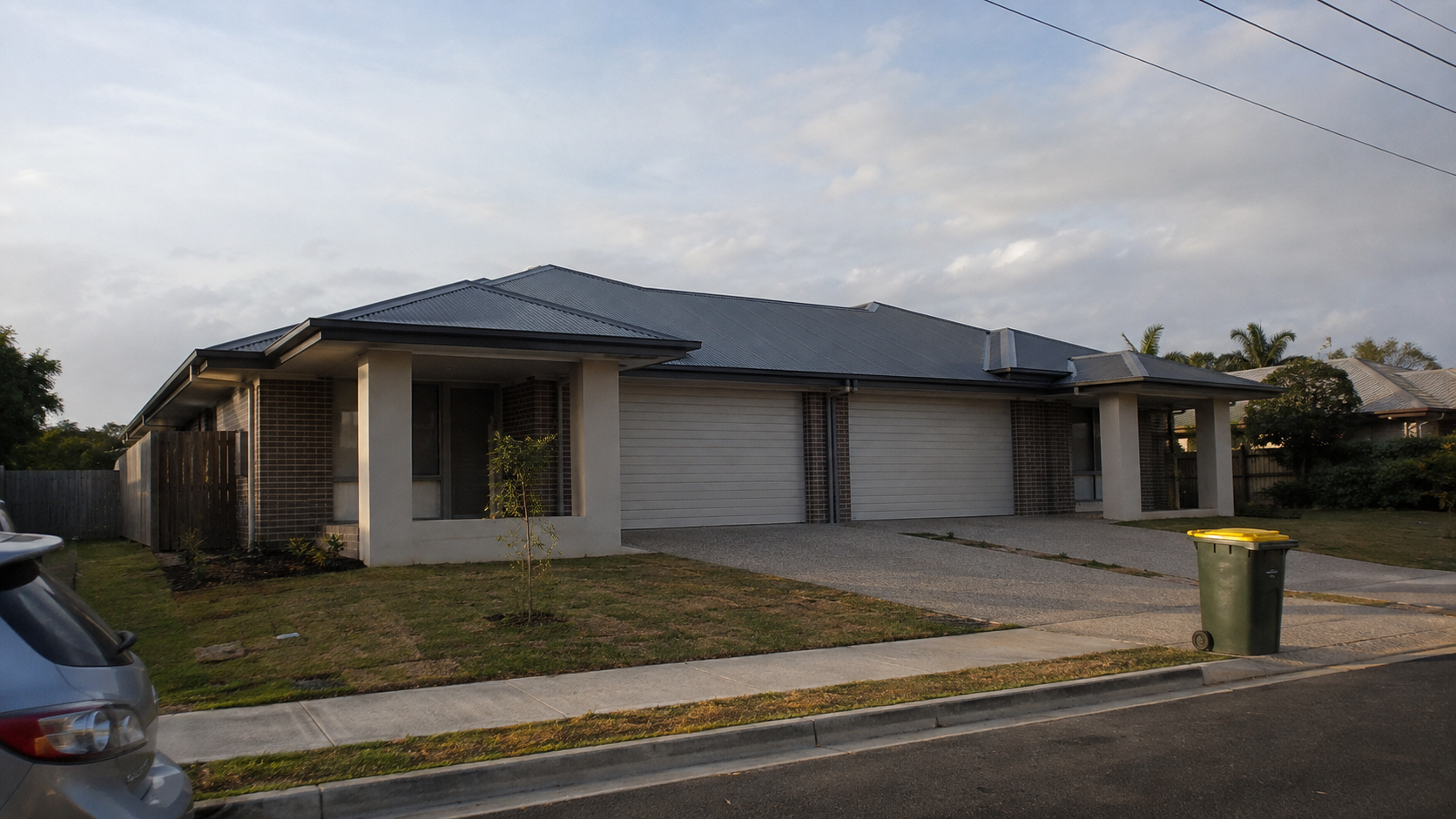
In March 2026, a National Investment Advisory client acquired a purpose-built duplex investment in the Hervey Bay region of Queensland for a total land-and-build package price of $1,143,000, covering both the land and the construction of the duplex. The strategy combined an 815m² landholding, two separate three-bedroom residences, two streams of rent and the opportunity to create value between what it cost to buy and build and what it was worth once complete.
By August 2026, the completed property received a bank valuation of $1,390,000, the value a lender placed on it for lending purposes. The valuation sits $247,000 above the original cost, or approximately 21.6% higher. Both residences are rented for $650 per week, producing combined gross rental income of $1,300 per week, or $67,600 per year, which equates to a gross rental yield of around 5.9%, meaning the annual rent as a percentage of the total cost before expenses.
The Investment at a Glance
| Investment detail | Outcome |
| Purchase/acquisition | March 2026 |
| Total land + build cost | $1,143,000 |
| Land size | 815m² |
| Combined build area | Approx. 303m² |
| Configuration | 2 × 3 bed, 2 bath, 1 car |
| Bank valuation (August 2026) | $1,390,000 |
| Valuation uplift | $247,000 |
| Valuation uplift % | Approx. 21.6% |
| Actual rent, Residence 1 | $650 per week |
| Actual rent, Residence 2 | $650 per week |
| Combined weekly rent | $1,300 |
| Combined annual gross rent | $67,600 |
| Gross yield on original cost | Approx. 5.9% |
Why NIA Selected the Opportunity
The investment case rested on more than a belief that Hervey Bay property prices would rise. The property needed to make sense as part of a broader investment strategy.
NIA was looking for an opportunity with several characteristics:
- A substantial block of land underneath the dwellings
- More than one rental income stream
- Reliable tenant demand
- Long-term population and housing demand
- A land-and-build arrangement with the total cost fixed up front
- The potential for the completed asset to be worth more than the total cost of acquiring the land and constructing the duplex.
The objective was not to find the cheapest property available, or to buy in a market that was receiving media attention. It was to identify an asset where the property, location, rent and the way it was purchased all pulled in the same direction.
Two Residences. Two Income Streams. One Investment Strategy.
One of the defining features of this property is its duplex configuration. The development contains:
- Residence One – 3 bedrooms, 2 bathrooms, 1 car
- Residence Two – 3 bedrooms, 2 bathrooms, 1 car
Both residences currently achieve $650 per week in rent. For a portfolio investor, the attraction of a duplex is the potential for two incomes from a single property, rather than the two dwellings themselves.
Two tenancies can strengthen the property’s income and reduce reliance on a single tenant. As with any investment, a duplex only makes sense when the purchase price, location, build cost, tenant demand and finished value all support the strategy.
Where the $247,000 Valuation Uplift Came From
The headline outcome is the gap between what the property cost to acquire and build, and what the bank valued it at once complete. Instead of buying an established property for $1.143 million and relying on the market to lift its value, the client acquired the land and built a purpose-designed duplex. The finished duplex was then assessed by the bank at a considerably higher value than the land, and the build had a cost.
The outcome is therefore better understood as a combination of factors, which may include the acquisition terms, the cost of construction, the value of the finished duplex and movement in local prices. At NIA, we do not believe an investment should rely entirely on hoping that the broader property market goes up. Where possible, we look for investments with more than one reason for value to grow over time.
Hervey Bay’s Market Fundamentals
The individual property still needs a market capable of supporting it, and Hervey Bay has continued to show strong housing and rental conditions. PRD reported a median house price of $840,000 in the first quarter of 2026, up 13.5% on the same quarter in 2025.
PRD also reported a median house rent of $650 per week and a 1.6% vacancy rate (the share of rental properties sitting empty) in March 2026. The median rent is particularly relevant here, because each of the two homes currently achieves the same $650 per week.
The population is also expected to keep growing. Fraser Coast Regional Council’s planning projections have the region reaching 144,833 people by 2036, and the Queensland Government’s draft Wide Bay Burnett Regional Plan points the same way, projecting the Wide Bay Burnett region as a whole, which includes the Fraser Coast, to grow from 310,730 people in 2021 to between 359,190 and 414,775 by 2046.
Population growth alone does not make an investment property suitable. What matters is the relationship between population, employment, housing supply, affordability, rental demand and the quality and price of the individual asset.
Housing Supply Matters
One of the fundamentals NIA considers when researching a property market is how future demand lines up against future housing supply. The same draft regional plan estimates the Wide Bay Burnett region will need between 25,800 and 48,945 new dwellings by 2046. At a local level, PRD’s 2026 Hervey Bay research identified approximately $388.4 million in planned development due to commence in 2026, while noting that very little of that pipeline is stand-alone housing ready for sale.
Housing undersupply does not automatically push property values up. When population and rental demand keep rising while new housing remains constrained, however, it can create conditions that support both property values and rents over the longer term. This formed part of the reasoning behind NIA’s interest in Hervey Bay.
Manufactured Value Versus Market Growth
This case study also highlights an important distinction in property investment. There are broadly two ways an investor may experience an increase in property value.
- Market growth
The surrounding property market increases in value over time. This can occur because of changes in supply, population, affordability, employment, infrastructure, buyer demand and broader economic conditions.
- Manufactured or created value
The investor acquires or develops an asset where the completed value is higher than the total cost required to create it.
In this case, the $247,000 difference between what the duplex cost in total and what the bank later valued it at cannot be attributed to one factor alone. The result reflects the value of the completed duplex within a strengthening market, which is a more useful way to read the outcome than labelling the entire amount as short-term capital growth.
Why the Land Was Important
The duplex was constructed across an 815m² allotment. For investors holding residential property over decades, the land component can be an important consideration because land is finite while buildings can ultimately be replaced.
This does not mean bigger land automatically delivers better investment performance. Location, zoning, usability, supply, property configuration and local demand all matter. Even so, pairing a substantial block with two modern three-bedroom homes gave this investment appeal both as a rental and as a longer-term portfolio holding.
What This Case Study Demonstrates
There is a temptation with successful property case studies to focus only on the headline number, and $1.143 million to $1.390 million certainly attracts attention. The more important lesson is how the different parts of the investment reinforced each other.
The property offered:
- A strategically selected market
- An 815m² landholding
- Two separate three-bedroom residences, each with its own tenant
- A 5.9% gross yield on original cost
- A bank valuation $247,000 above the original land-and-build cost.
The case for the purchase rested on all of these lining up at once, and removing any one of them would have weakened it. For exactly that reason, property should be chosen within an overall investment strategy rather than because it sits in a popular suburb.
The Lesson Isn’t “Everyone Should Buy a Duplex in Hervey Bay”
Property investment is not one-size-fits-all, and the right investment depends on the investor’s:
- Income
- Available capital
- Borrowing capacity
- Existing property portfolio
- Cash-flow position
- Investment timeframe
- Risk tolerance
- Long-term financial objectives.
For this particular investor, the Hervey Bay duplex offered a compelling combination of land, rental income, market fundamentals and completed value. Another investor may require an entirely different property, which is why we believe the strategy should come before the property.
Strategy Before Property
A successful property investment should not be judged only by whether prices went up after it was purchased. The better questions are:
- Why was the property selected?
- What role does it play within the investor’s portfolio?
- How does the rental income affect the cost of holding the property and future borrowing capacity?
- Will people still want to live there in ten years?
- Was the property acquired at a commercially sensible price?
- Does the investment help the client move closer to their broader financial objectives?
In Hervey Bay, the build cost, the valuation and the actual rent added up to a strong early outcome. The first valuation is only the beginning. The real objective is for each investment to serve as another step towards a long-term property portfolio.
Build a Property Portfolio With a Plan
Putting the strategy before the property is where National Investment Advisory comes in. We help Australians build residential property portfolios around their financial position, borrowing capacity and the goals they are working towards. The work starts with strategy, then moves through market research, property sourcing, due diligence, finance coordination, acquisition, construction and settlement, and continues with ongoing portfolio review once the property is held.
Each of those stages comes back to the same question. Many investors begin by asking “Where should I buy?” The more useful question, and the one that shapes every stage above, is “What does my portfolio need next?”
Ready to understand what your property investment strategy could look like? Book a Strategy Session with National Investment Advisory and start with the plan before choosing the property.
Individual investment results vary. The figures above relate to this specific property and client transaction and should not be interpreted as a forecast or guarantee of future performance. Property values and rental income can rise or fall. Bank valuations are assessments at a point in time and may change. This information is general in nature and does not constitute personal financial, taxation, legal or credit advice.
RElated articles
View More Articles
Explore more insights. These hand-picked articles dive deeper into practical ideas, strategies and lessons to help you keep learning.